

Discovering the Human Core of Care
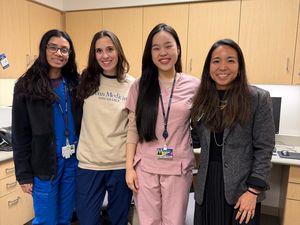 Vietnamese medical student Pham Phuong Dung’s Fall 2025 exchange at Penn transformed her view of research and care. Beyond technical skills, she gained insight into collaborative teams, patient-centered research, and the human core of medicine.
During the Fall 2025, a Vietnamese medical student Ms. Pham Phuong Dung traveled to the US to participate in a research exchange with Dr. Catherine Lai’s team at the Penn Leukemia Clinical Research Unit. What began as an international opportunity to strengthen her research skills became a transformative experience, one that reshaped how she understands medical research, clinical teams, and the human dimensions of research.
Dung arrived at Penn expecting to refine her technical competencies in data collection and study design. Instead, she encountered a new work culture that challenged her assumptions about how research teams function. From her first team huddle, she was struck by the group’s strong sense of shared responsibility. Meetings were focused, tasks were clearly structured, and the work was treated as a collective commitment rather than an individual burden. Team members consistently supported one another, creating an environment where efficiency and mutual respect went hand in hand.
What truly distinguished my time at Penn was the work culture, where collaboration was embraced as a shared responsibility. - Dung Pham
From the outset, Dung was entrusted with meaningful responsibility. She contributed to drafting sections of the research protocol, reviewed IRB materials, and developed recruitment flyers and participant tracking sheets. What initially felt overwhelming quickly became empowering, as her colleagues offered thoughtful, constructive feedback and worked through challenges alongside her. This trust and mentorship transformed her role from observer to active contributor, strengthening both her confidence and her sense of ownership over the study’s data collection process.
Beyond the research lab, Dung gained valuable exposure to Penn’s inpatient and outpatient clinical settings. During a two-week inpatient research rotation, she joined daily rounds and observed multidisciplinary teams communicating seamlessly, with each member contributing specialized expertise. Some of the most formative moments occurred during emotionally charged conversations surrounding end-of-life care—encounters shaped not only by clinical gravity, but by compassion, clarity, and deep respect for patients and their families.
It was a powerful reminder that medicine, at its core, is deeply human." - Dung Pham
In the outpatient clinic, Dung observed patient visits and learned firsthand how blood cancers are managed across different stages of illness. What resonated most deeply was the strength of the physician–patient relationship. Conversations frequently extended beyond medical details to include personal stories, values, and discussions of quality of life. Through these encounters, Dung came to appreciate the complexity of patient-centered research and care. She recognized that what feels appropriate or comfortable for one patient may not be for another—and that these differences directly influence patient engagement, trust, and the quality of research data.
During the final days of the exchange, Dung identified important patterns in survey participation. Patients were far more likely to complete surveys when approached in person during clinic visits than when contacted by phone or email. Many preferred physical consent forms over digital versions and appreciated the option to take home printed QR codes to complete surveys at their own pace. These insights reinforced a growing realization: effective research design depends as much on empathy and accessibility as it does on methodology.
By the end of her exchange, Dung had gained far more than technical research experience. She left with a deeper understanding of empathy, communication, and collaboration as essential pillars of medicine—principles she will carry forward into her future clinical training. The experience reinforced her belief that while scientific rigor forms the foundation of healthcare, it is human connection that gives the work its true meaning.
While technical knowledge forms the foundation of healthcare, it is compassion and collaboration that bring meaning to the work we do." - Dung Pham
Penn’s Center for Global Health hosts international medical students for research experiences to share Penn’s best practices in academic research with aspiring researchers from around the world. These internships build long-term, reciprocal partnerships, strengthen research capacity at partner institutions, and promote cross-cultural collaboration—ensuring knowledge and innovation flow in both directions to advance global health equity.